


 Corporate Events.
From AI to IPO: GrandTech Cloud Services Connects Capital, VCs, and Ecosystem Partners to Empower Startups Globally
GrandTech Cloud Services (GCS) successfully concluded its two-week seminar series, “AI Transformation for Startups: Transformation and Growth,” on September 4. The events brought together more than 100 Taiwanese startup founders and senior executives for in-depth discussions and experience sharing, covering topics ranging from practical AI implementation to capital market planning. The initiative not only put GCS’s long-standing F2SU (A Friend to Startups) philosophy into action but also demonstrated the shared vision of Taiwan’s startup community to exchange insights and grow together.
Building a Stronger Startup Ecosystem: GCS Chairman Frankie Hsu Encourages Startups to Leverage Ecosystem Partners to Compete Globally
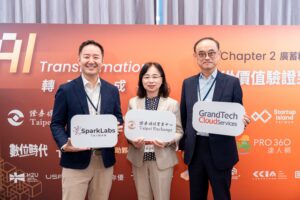
Photo (from left to right): Edgar Chiu, Co-founder of SparkLabs Taiwan; Flora Lee, Deputy General Manager of Taipei Exchange (TPEx); and Frankie Hsu, Chairman of GrandTech Cloud Services.
Frankie Hsu, Chairman of GrandTech Cloud Services, emphasized: “For startups to truly scale, technology alone is not enough. They also need strategy, talent, capital, industry networks, and the experience and resources accumulated along the way. Going it alone is never easy. What matters is leveraging the strengths of ecosystem partners.”
Hsu noted that mentors, venture capital firms (VCs), corporate venture capital firms (CVCs), and capital market institutions such as the Taipei Exchange (TPEx) can all provide critical support at different stages of a startup’s development. By connecting capital, talent, expertise, and market resources, these partners can help startups progress from growth toward an IPO. When these resources extend across markets, startups can achieve cross-border scale and compete on the global stage.
85.1% of Surveyed Startup Founders Say Their Ventures Are AI-Related: AWS Architect Highlights How Managed Platforms Help Startups Focus on Products
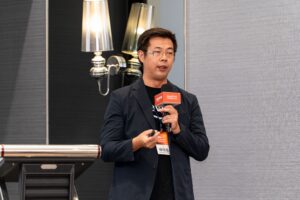
According to the Ministry of Economic Affairs’ 2025 White Paper on Startups, Taiwan had a total of 10,552 startups. The report also found that 85.1% of surveyed startup founders said their ventures were related to AI, reflecting the growing influence of AI across Taiwan’s startup ecosystem.
Jack Hsu, Senior Solutions Architect at Amazon Web Services (AWS), a supporting partner of the event, explained that for AI startups, technology architecture affects not only product development speed but also cost efficiency, service reliability, and future scalability. Through managed platforms and Serverless architecture, startups can adopt a pay-as-you-go model, reduce infrastructure investment, and scale resources flexibly according to demand, allowing them to focus on product development and market growth.
As AI applications increasingly incorporate multiple models and specialized AI agent architectures, businesses are placing greater emphasis on model flexibility, data security, and private deployment capabilities. Cloud architecture enables companies to select models based on specific use cases while leveraging enterprise-grade security mechanisms, reducing dependence on any single model or provider.
From cost efficiency and architectural flexibility to AI security and scalability, technology infrastructure is no longer merely the foundation supporting product operations. It has become a key factor in helping AI startups build market trust, accelerate commercialization, and achieve sustainable growth.
Stan Shih: “AI Should Be Applied to Business Operations to Help Taiwan Take Off Across the Board”
In a recent interview, Stan Shih, Founder of Acer, shared his perspective: “Taiwan is currently a winner, but its success is largely concentrated in AI-related manufacturing. The next step is to apply AI to business operations so that Taiwan can take off across the board. Startups are inherently equipped with cloud-native and AI-native capabilities. The growing adoption of AI in business operations is poised to become a new driving force behind Taiwan’s economic transformation.
Planning Ahead for Capital Markets: TPEx Deputy General Manager Flora Lee Highlights Listing as a Pathway to Long-Term Growth
Flora Lee, Deputy General Manager of the Taipei Exchange (TPEx), which served as the event’s guiding organization, outlined a capital market roadmap for startups. She emphasized that companies can progressively access capital market resources through different stages and mechanisms, including the Go Incubation Board for Startup and Acceleration Firms (GISA), the Emerging Stock Board (ESB), and TPEx listing, depending on their stage of development, corporate governance readiness, and capital requirements.
Lee stressed that listing should not be viewed as an option to consider only in the later stages of a company’s development. Instead, startups should familiarize themselves with relevant requirements and regulations early on, gradually strengthening corporate governance, operational fundamentals, and capital planning. Early preparation not only establishes a solid foundation for future fundraising but also enhances market visibility and brand credibility, creating a pathway for long-term corporate growth through the capital markets.
Public and Private Sectors Working Together: A Golden Era for Taiwan’s Startup Ecosystem
As cloud and AI technologies continue to mature, Taiwan’s startup ecosystem is gaining momentum through collaboration between the private and public sectors. From GrandTech Cloud Services’ commitment to promoting the F2SU philosophy, to the participation of leading venture capital firms and accelerators such as SparkLabs Taiwan, Hive Ventures, Cornerstone Ventures, Venture+, and CDIB Innovation Accelerator, as well as the policy support and initiatives of the Taipei Exchange, Taiwan’s startups are benefiting from an increasingly comprehensive ecosystem. Together, these efforts are creating favorable conditions for startups to innovate, grow, and expand into international markets.

